- Database Server
- MariaDB is preferred and what we use
- Database Management Tool
- HeidiSQL is free and what some of us use
*** SVN Access ***
- username anonymous
- no password
Setting up the folder structure
Create a folder in the root of your drive c: named EQ2.
Inside the EQ2 folder create a folder named Source. Go ahead and create another folder named Server as well. Additionally you should create another folder called EQ2client (where the backup copy of your client should go).
Getting the source
In order to download the source a GUI subversion client such as TortoiseSVN is recommended to retrieve the source code. TortoiseSVN will be used in this guide.
Once TortoiseSVN is installed right click on your newly created Source folder and choose SVN Checkout. The following URL is required in the window that pops up. Enter it in the URL of repository.
https://svn.eq2emulator.net/svn/eq2server
Also make sure the Checkout Directory is the directory you want to download the source to (C:\EQ2\Source). It should look similar to this image.
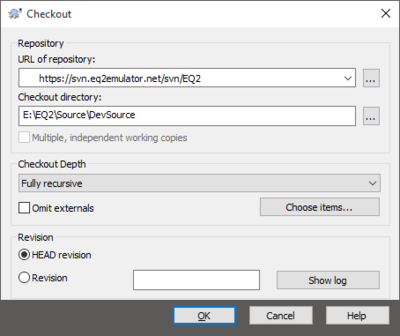
If this is your first visit to the SVN, you will be greeted by a Certificate validation failed popup. You will have to validate the certificate before you can proceed. Choose either the Accept the certificate or the Accept the certificate permanently. The latter option will not prompt you again to validate the certificate.
This is safe as long as the certificate is from MMO, MMOE, Phoenix, AZ, US.
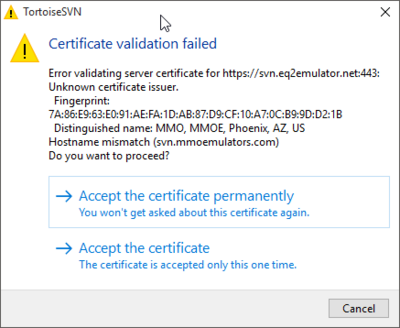
Once you are past that...
It's time to enter the login credentials.
SVN Access Username: anonymous (no password required)
Sit back and let the source code download.
Compiling the source
This guide is going to be using Visual Studio 2017 Community Edition.
- Open EQ2WorldVC10.sln in the win folder and run through the conversion wizard.
- In Visual Studio 2010, 2012, or 2013 right click the project and select properties
- Under the VC++ Directories: ensure the following are included (should be configured already) (the same x64 equivalents if compiling x64)
- Include directories
- $(SolutionDir)..\source\depends\mariadb-10.1.19\include;
- $(SolutionDir)..\source\depends\zlib\include
- Library directories
- $(SolutionDir)..\source\depends\mariadb-10.1.19\lib;
- $(SolutionDir)..\source\depends\zlib\lib
- Choose Debug or Release and the architecture you want to build for 32 or 64
Setting up the Server folder
Remember that Server folder you created way back at the beginning of this guide? Now we are going to use it.
Once you have navigated to your Server folder, create a new folder "worldserver" inside the Server folder. If you plan on using the minilogin (local login server) create another folder "loginserver" there as well.
We will need to move our compiled binaries over along with some other files. Let's go ahead and open our worldserver folder. To make things easier, open up a new window and navigate to C:\EQ2\Source\trunk\bin. Depending on the architecture you choose to build for will be the file you need to move to your worldserver folder. If you built for a 32-bit system then you will want to move EQ2World.exe. If you built for a 64-bit system then you will want to move EQ2World_x64.exe. Go ahead and move the file over to your worldserver folder now.
Head over to the structs folder located in C:\EQ2\Source\trunk\structs. We need to copy (not move) these files to our worldserver folder also.
- CommonStructs.xml
- ItemStructs.xml
- SpawnStructs.xml
- WorldStructs.xml
Time to copy config files to the worldserver folder. Locate the config files in C:\EQ2\Source\trunk\configs. There should be three files located there.
- log_config.xml
- LoginServer.ini
- world_db.ini
Move all three of these to the worldserver folder.
Once this is complete, let's get some content before we move to configuring our server.
Getting Content
Steps
- 2. Complete the Login Account Registration and verify that your account was created successfully.
- 3. Go to the Account Management Page and complete this form to register your game server with the public Login Server (You will need to provide the Login Account information from step 2 as well).
- 3.1 Login Account Name - This is your Login Account Name that you created in step 2.
- 3.2 Login Account Password - This is your Login Account Password that you created in step 2.
- 3.3 World Account Name - Account name that will be used by the server to login.
- 3.4 World Account Password - Password that will be used by the server to login.
- 3.5 Verify Password - Verify the password in 3.4 is correct - type it again
- 3.6 World Server Name - Name used to identify your server.
- 3.7 World Description - Brief description describing your world.
- 4. Download the latest Stable Win32 binary from one of the links on our SVN Links page.
- 5. Once you have it downloaded, use a zip utility to extract all the files into a work directory of your choice.
- 6. Install MySQL 5.0.27 if possible, but any MySQL distribution after 5.0 should work fine. Visit mysql.com locations or for helping in installation/configuration. If you are experienced with mysql you may run the commands directly instead of following Step 7's GUI setup.
Otherwise:
- 7. Download and install HeidiSQL, SQLYog or any MySQL (official) GUI Tools. Using HeidiSQL as an example tool (interpret this for your own GUI if you do not use HeidiSQL):
- 7.1 Once it is installed, login to your MySQL database using the root login that you created when you installed MySQL in step 6.
- 7.2 Create a database by clicking Tools, Create Database. Use eq2 as the database name.
- 7.3 Click on Tools, User-Manager and under credentials enter a username and password that you would like to use for your server. If you will be accessing the database from multiple computers then leave it %. Otherwise set it to either your computer's IP address or localhost.
- 7.3 Click on the "All Privileges" checkbox and in the "Allow access to:" box, click on the eq2 database.
- 7.4 Click create.
- 8. Open world_db.ini in the work directory that you created in step 5.
- 8.1 Edit the information in this file to match the user that you created in step 7. Host in the database server address. It will be localhost if it is being run from the same machine you are using.
- 9. Open LoginServer.ini in the work directory that you created in step 5.
- 9.1 Replace WORLD_NAME_HERE with the World Server Name you created in step 3.1.
- 9.2 Replace EXTERNAL_IP_HERE with either localhost if you want to only allow yourself to login, or replace it with your external ip address. You can get this by browsing to http://www.whatismyip.com
- 9.3 Update account and password with the information that you created in step 3.2 and 3.3 respectively.
- 10. Start eq2world.exe. If everything starts correctly, your almost ready to play.
- 11. Edit the eq2_default.ini file in your EverQuest2 client directory and set the cl_ls_address to:
cl_ls_address eq2emulator.net
- 12. If everything was setup correctly, you should be able to run the EQ2 client and connect to your world. NOTE: Be sure to run EverQuest2.exe!!! If you run EQ2.exe, it will patch all your files including eq2_default.ini.
Configuring your server
Time to configure your server to use your database and loginserver.
Set up you world_db.ini to connect you server with a database.
Configure the LoginServer.ini to point your server at the official login provided by Eq2emulator.net, or to a minilogin for private play.
If you would like to know more about the log config, visit the log_config.ini page.
You can visit the SVN Page for source, content, and tools.
==
Original guide taken from EQ2Emu Forums posted by Razmalone
Origional Post Here
Updated here by theFoof 3/10/13
Updated again by Cynnar 1/10/18
Update is in progress
==
|

